Skip to content
Erotic hypnosis · For consenting adults, 18+
Mira Janssen

Learn hypnosis: the first
proof, tonight

Magnetic fingers — four minutes, two hands, nothing else. How strongly it works differs from person to person.

Almost everyone who wants to learn hypnosis starts in the wrong place: with a long induction, a solemn voice, and the quiet hope that something big is about to happen. Usually nothing happens at all — and afterwards both of you are unsure whether any of this works.

Before you begin

Before you begin

Not at the wheel, not near machinery, not after alcohol. With epilepsy, psychosis or ongoing psychiatric treatment, ask a doctor first. Say beforehand that either of you can stop at any moment — and mean it.

This is not therapy and does not replace any. It is an exercise between two consenting adults.

What you need

What you need

Sit facing each other, both comfortable, feet on the floor. Enough room to stretch your arms out. No phone in sight.

Speak more slowly than feels right — roughly one sentence per calm breath. This is the most common mistake, not the wording.

Say what this is: no test, nothing to pass, and it can end at any time.

Sit facing each other, both comfortable, feet on the floor. Enough room to stretch your arms out. No phone in sight.

Speak more slowly than feels right — roughly one sentence per calm breath. This is the most common mistake, not the wording.

Say what this is: no test, nothing to pass, and it can end at any time.

The wording

The wording

Anything in italics is not to be spoken — it is for you. The line breaks are breathing marks; read them as pauses.

Wait until she is sitting calmly and breathing evenly. Only then begin.

Please stretch both arms out in front of you, at shoulder height. Palms facing each other, about a hand's width apart. Index fingers extended, the other fingers loosely interlaced.

Wait until the posture really holds. Correct briefly and kindly, without explaining.

Good. Exactly like that. And now look at the gap between your fingertips. Not at the fingers — at the space between them.

From here on, slow down. One sentence per breath.

And while you look there, you may notice that the air in that gap grows a little denser. As if something were there. Something that pulls.

Imagine a small magnet sitting in each fingertip. Two magnets, drawn to each other. And the longer you look, the stronger the pull becomes.

You don't have to do anything. You don't have to move the fingers. They move by themselves, piece by piece, towards each other. Pulling. Closer. Closer.

Repeat “closer” in the rhythm of the actual movement — faster when the fingers speed up. Describe only what you see; claim nothing.

And the moment they touch, the pull eases, and your arms may sink all by themselves.

Wait for the touch, however long it takes. If the fingers stop halfway, that is a result like any other — not a note of disappointment.

Very good. Let the arms sink, take one deep breath. What did you feel?
How you know it held

How you know it held

Not by the speed. A hesitation of half a second before the fingers move is already the result: in that half second someone stopped steering their hands. That is the whole point.

Watch three things. Do the movements become smaller and more even instead of jerky? Does the gaze go soft and fixed at the same time? And does the answer to your last question take a moment longer than usual? Each of these is a sign that attention has moved inward — the first evening needs no more than that.

When it doesn't work — the three usual reasons

When it doesn't work — the three usual reasons

If the fingers stay put, it is almost never the person.

By far the most common reason. What feels slow while speaking is usually still brisk. Take out a third of the pace.

“Your fingers are pulling together” is a claim that can be disproved. “You may notice that …” cannot. Describe, don't command.

Whoever holds their arms with effort feels effort — not the pull. If need be, start lower, at chest height.

Let the arms sink, talk about it briefly, and if you want, begin again more slowly. Two calm attempts are worth more than one hurried one.

By far the most common reason. What feels slow while speaking is usually still brisk. Take out a third of the pace.

“Your fingers are pulling together” is a claim that can be disproved. “You may notice that …” cannot. Describe, don't command.

Whoever holds their arms with effort feels effort — not the pull. If need be, start lower, at chest height.

Spoken too fast
Too certain in tone
Uncomfortable posture

Always bring them back

Always bring them back

Even this short attempt ends with an announcement: release, breathe, one sentence back into the room. Never simply move on to the next topic — this is the part almost everyone skips, and the only one that is not optional.

“I'll count from three to one. At one you are wide awake and here in the room. Three — the pull eases. Two — the arms are yours again. One: fully here, eyes open.”

If someone seems dazed for longer afterwards: speak to them calmly, give it time, a glass of water. No alcohol, and no driving for the next half hour.

Where to go from here

Where to go from here
Further, together
The Masterclass, Volume One takes the craft in the order it is needed in the room — with one script per chapter.
Know what you respond to
The suggestibility test shows in twelve questions which channel trance comes most easily through for you.

Common questions

Can you teach yourself hypnosis?

The basics, yes. Ideomotor exercises like this one, a simple induction and a clean emergence can be worked out by two people from a written guide — it takes nothing more than a text, time and a consenting second person. What cannot be learned from a text is how to handle people in whom something unexpected surfaces. That is what training courses are for, and that is what they are good at.

How long does it take to learn hypnosis?

The first visible effect — this one — takes four minutes. An induction that works reliably is a few evenings of practice. Guided courses run from a few days to several weeks depending on the format. There is no guarantee in any of these cases: people respond differently, and that is not a question of talent or willpower.

Who is allowed to learn hypnosis?

Nothing on these pages is treatment. Who may call themselves a hypnotist, and who may treat illness with hypnosis, is regulated differently in every country — look up what applies where you live. What is here is expressly not therapy and treats nothing.

What is the easiest way to learn hypnosis?

By not starting with an induction, but with a small, checkable effect — exactly as above. The reason is practical: a ten-minute induction whose effect you cannot judge unsettles both of you. Four minutes with a visible result give you the calm you need for everything that follows.

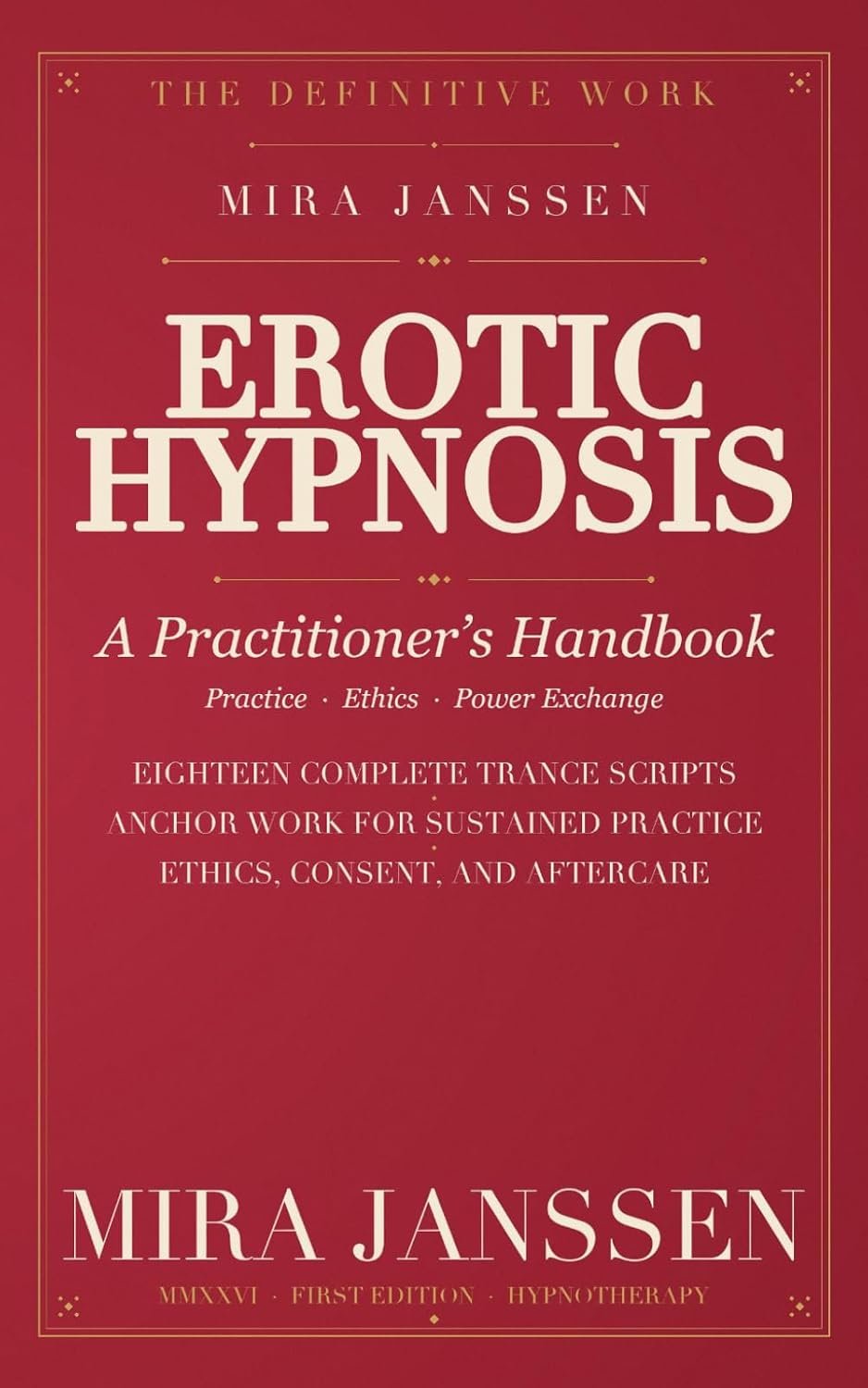
Erotic Hypnosis — The Handbook
Read on

Erotic Hypnosis
The Handbook

Eighteen complete trance scripts, anchoring, ethics and aftercare.

To the book