Erotic Hypnosis Research: What the Sources Actually Say (and What They Don't)
About once a month, somebody asks me for "the studies". A journalist on deadline, a sceptic mid-argument, a reader wondering how much concrete sits under my books. They all want the same document: erotic hypnosis research, meaning a tidy stack of peer-reviewed papers, with sample sizes and effect estimates. I do not have that document. As far as I have been able to establish, nobody does. What I can offer is the honest map — what exists, what kind of evidence it is, where the edges of the record lie. This page is that map, dated August 2026.
The short answer
Erotic hypnosis research is the documented evidence for using hypnosis in erotic settings — and the honest version of that evidence, as of August 2026, is not a stack of trials. The general science of hypnosis is substantial: a century of laboratory work, standardised susceptibility scales, brain imaging, and a clinical record densest in pain and irritable bowel syndrome. The literature specifically on erotic hypnosis is a different animal. Everything I have been able to verify is practitioner-made — books, training events, teaching videos, podcast archives — plus one academic anchor: a 2022 talk on kink practices, erotic hypnosis among them, given to a special interest group of the Society for the Scientific Study of Sexuality by a social-psychology researcher. A talk, not a trial. I have found no controlled outcome study of any erotic protocol. The mechanisms carry over from mainstream research; the outcome claims do not — they rest on practitioner experience, and the honest practitioners say so themselves.
Two literatures, one of them thin
When people say "hypnosis research", they usually mean the big literature: the one that establishes the state as real, maps it in brain imaging, scores responsiveness on standardised scales, and builds its clinical case most solidly in pain and irritable bowel syndrome — a description of a record, not a treatment recommendation. I have laid all of that out in is hypnosis real and how hypnosis works, so I will not re-argue it here. It is genuine science, and almost none of it is about sex.
The erotic branch has a literature of its own. It is real, some of it is serious, and nearly all of it was written, filmed or recorded by practitioners rather than measured by researchers. That asymmetry is not a footnote to this subject. It is the finding.
What actually exists
Start with the closest thing the record has to an institutional anchor. In 2022, Sam Hughes — then a doctoral researcher in social psychology at UC Santa Cruz — gave an eighteen-minute talk to the BDSM and kink special interest group of the Society for the Scientific Study of Sexuality. Erotic hypnosis appears in it as one practice among several — pup play, furries, cuckolding — with clinical case examples in the mix. Hold both halves: a real researcher addressed a real scientific society about this practice, on the record — and it is eighteen minutes, shared with half a dozen other kinks, a talk rather than a peer-reviewed study. In everything I have verified, this is the high-water mark of academic attention.
Then the practitioner shelf, where the depth lives. The English-speaking field has a standard text: Mark Wiseman's Mind Play: A Guide to Erotic Hypnosis. Wiseman also appears in recorded conversation with Kaz Riley — a hypnotherapist and trainer who founded a practice called Sexual Freedom Hypnosis — and their half-hour discussion of ethical erotic hypnosis lets you watch two senior figures compare notes in public. There are career educators like HypnoStory, twenty-five-plus years in, teaching at the community's own events — Charmed, Beguiled, NEEHU — whose two-hour conversation on the psychology of hypnokink is the most material-dense item I catalogued. The scene is not monolingual either: the German-language educator Undine de Rivière publishes short videos that take myths apart and demonstrate classics like hand catalepsy, and spent two hours as a podcast guest explaining orgasm triggers — that show's only hypnosis episode in three hundred and thirty-four.
Beneath the books sit the podcast archives. An English-language kink-education show, Mind Kink, keeps roughly thirty-five episodes accessible, including a two-hour class on making suggested changes permanent — consent and context treated as constitutive parts of the technique, not paperwork around it — and a boundaries episode built on one sentence worth framing: someone who cannot say no cannot fully say yes. A German-language hypnosis podcast holds forty-one episodes — a safety episode, a two-parter on long-term conditioning and trigger work, and a fifty-eight-minute episode from July 2026 working through fifteen circulating claims, from orgasm on suggestion to switched-off pain, under a title that translates as "Erotic hypnosis: what actually works?". Fifteen claims under discussion is not fifteen findings — when the practitioners themselves are still asking the question, the answer is not settled.
The bridges to the clinical world are thin but real: a clinical hypnosis practice devoted a 2020 episode of its own podcast to erotic hypnosis as a "third genre" — power exchange, shame — and a sexology podcast has visited twice, once with Dr. Amy Marsh and again in 2025 on kink and hypnotherapy.
Now look at the shape of that shelf. Books by practitioners. Talks by practitioners. Conversations between practitioners. One researcher, one scientific society, eighteen minutes. What this record documents is practice — how experienced people do the thing, teach the thing and argue about the ethics of the thing. What it does not contain, anywhere I have looked, is measurement: no controlled comparison, no outcome counting, no study that takes an erotic protocol and checks what it delivers.
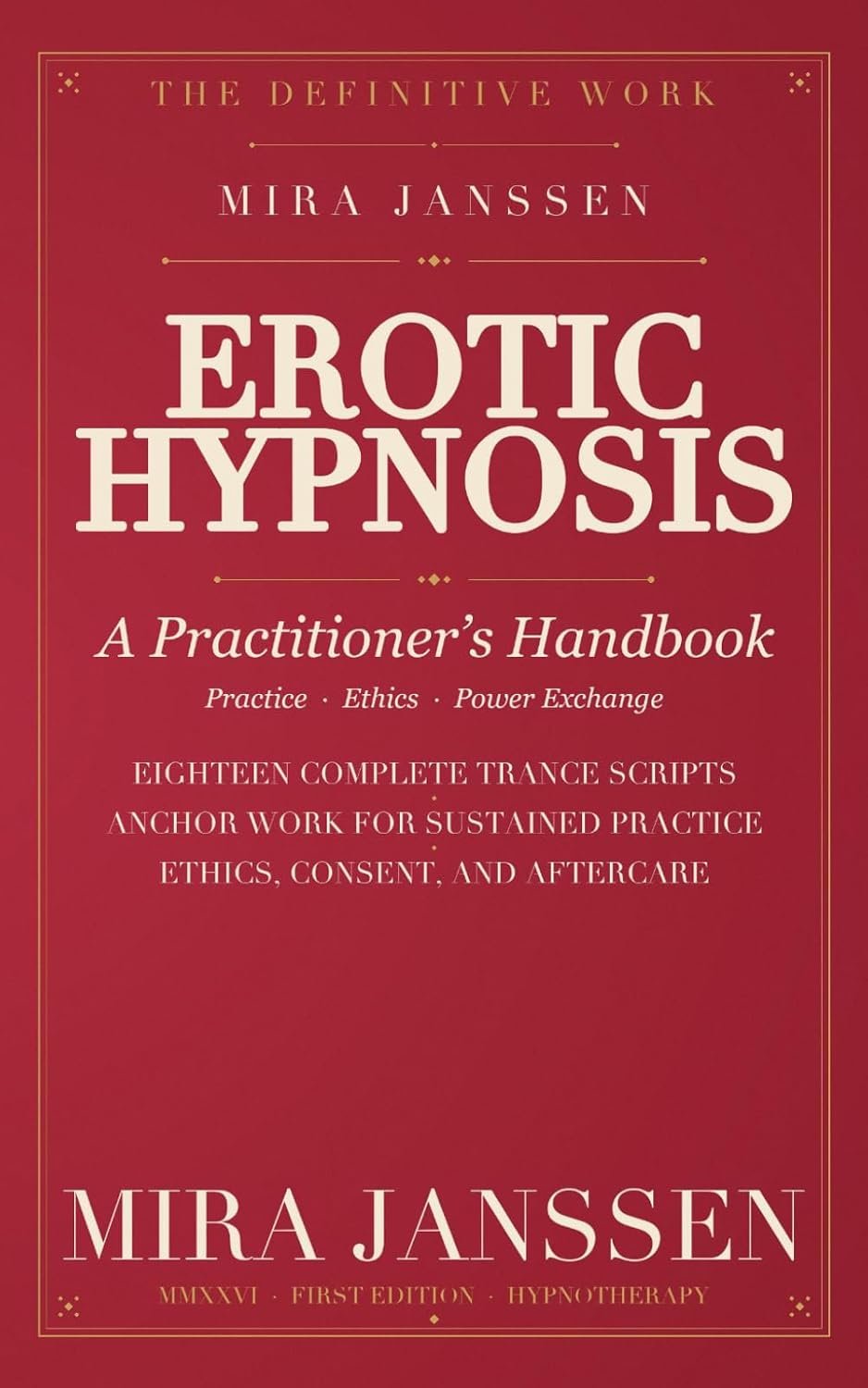
Eighteen complete sessions written out to read aloud — from the first agreement to the way back. The book for turning one attempt into a repertoire.
See the bookWhat it took to verify even this
I want to show you the floor under this page, because the floor is part of the story. Three things happened while I assembled the source list. An episode I had marked as among the most valuable became unverifiable before I could use it — the host's archive and feed now return zero episodes — so it is out. My first research pass reported a detailed episode with a named guest; my second pass searched the show's transcript archive in full and found no such episode. The second pass refuted the first — which is exactly why one runs two. And a Portuguese-language podcast on the subject stated in its own description that it had been created using artificial intelligence. Out as well.
That is a niche evidence base up close. Episodes vanish when hosting lapses. Honest errors propagate until somebody re-checks. Machine-generated content seeps into the record wearing the costume of expertise. A thin literature is not merely small — it is fragile, and its footnotes need checking more often than a fat one's.
What carries over from the big literature — and what doesn't
Here is the good news: the machinery of hypnosis is not erotic-specific. Narrowed, absorbed attention works the same whatever the subject matter. Suggestion and expectation behave the way the expectancy research describes — what a person anticipates shapes what they experience, which is the usable half of the placebo effect. Ideomotor responses, imagination reaching the muscles without passing through a decision, have been demonstrated for nearly two centuries. Responsiveness remains a trait: roughly normally distributed, stable over time, dramatic in a minority and nearly absent in another. None of these mechanisms care what a suggestion is about, which is why the general research carries into the bedroom as cleanly as it carries anywhere.
What does not carry over is outcomes. The clinical literature earned its density in pain and irritable bowel syndrome with controlled trials; you cannot borrow that density to certify an orgasm protocol. Whether a given erotic technique produces a given result, in what fraction of people, how durably, at what risk — those are empirical questions, and in the record I can verify, nobody has measured them. Even the theory talk needs date-checking: a 2014 interview still in circulation leans on theta waves, which is not how current imaging describes the state. No scandal — real effect, wrong story is the oldest pattern this subject has; mesmerism is the original public case.
The inventory
This is the part of the page built to be cited: "support" is the best evidence I could verify as of August 2026, "confidence" my honest reading of it.
| The claim | Best available support | Confidence |
|---|---|---|
| Hypnosis is a real, measurable state | A century-plus of laboratory work and brain imaging | Settled |
| Responsiveness is a stable, unevenly spread trait | Standardised susceptibility scales; roughly normal distribution — see the suggestibility test | Settled |
| Expectation shapes hypnotic response | Expectancy research in the general literature | Strong |
| Ideomotor responses are real and involuntary | Classic demonstrations, reproduced for nearly two centuries | Strong |
| Suggestion can alter perceived sensation | The best-studied corner of the general record (pain) | Strong in general — untested on erotic protocols, as far as I can verify |
| Erotic hypnosis is a developed craft with a real community | Practitioner texts (Wiseman's Mind Play), training events, long-form recorded teaching | Well documented as practice — documentation, not efficacy data |
| Academic sexology is aware of the practice | One 2022 talk to a Society for the Scientific Study of Sexuality interest group | Thin but real — a talk, not a paper |
| Arousal, orgasm or lasting conditioning on suggestion works reliably | Practitioner accounts and podcast discussion only, in my record | Unmeasured — treat as experience reports |
| Theta waves explain erotic trance | A 2014 interview; not how current imaging describes the state | Outdated framing |
If someone hands you a claim from the bottom of that table dressed in the confidence of the top, they are doing marketing, not summary.
Why a thin literature demands thick ethics
In a field with outcome studies, a careless practitioner is eventually corrected by data. In a field without them, nothing corrects you except your own discipline and the consent culture of the people you practise with. That is not a reason to avoid erotic hypnosis; it is the reason this field's serious corners talk about ethics constantly — and the record shows they do. The standard text's author discusses the craft on camera under the word "ethical"; the densest technical class in the podcast record treats consent and context as constitutive; safety, aftercare and limits recur across the archives like a pulse.
Realistic expectations come from the same arithmetic. Responsiveness is spread out, the spectacular reports come disproportionately from the responsive minority, and anyone promising universal results is ahead of any evidence I can find. Thin evidence is not a licence to claim less carefully. It is an obligation to claim more carefully — and that obligation is the spine of my books, and of everything else on this site.
— Mira
FAQ
Is there scientific research on erotic hypnosis? On hypnosis in general, a great deal. On erotic applications specifically, the record I can verify consists of practitioner literature plus one 2022 conference talk to a scientific society; I have found no controlled outcome study of an erotic protocol.
What is the standard book on erotic hypnosis? Mark Wiseman's Mind Play: A Guide to Erotic Hypnosis is the standard text of the English-speaking field. It is a practitioner's craft manual, not a study — precisely the kind of source this field currently has, and worth knowing before you cite it as more.
Can practitioner knowledge be trusted without studies? The way any craft knowledge is trusted: provisionally, with the safeguards the field itself teaches. Treat outcome claims as experience reports, expect variation between people, negotiate consent before technique, and distrust anyone whose confidence outruns the record they can point to.
What did the 2022 SSSS talk actually cover? Sam Hughes, then a doctoral researcher in social psychology at UC Santa Cruz, gave an eighteen-minute talk to the BDSM and kink special interest group of the Society for the Scientific Study of Sexuality. Erotic hypnosis appears in it as one practice among several. It is a talk, not a trial, and that is the strongest academic item in the source package I can verify.
Eighteen complete sessions written out to read aloud — from the first agreement to the way back. The book for turning one attempt into a repertoire.
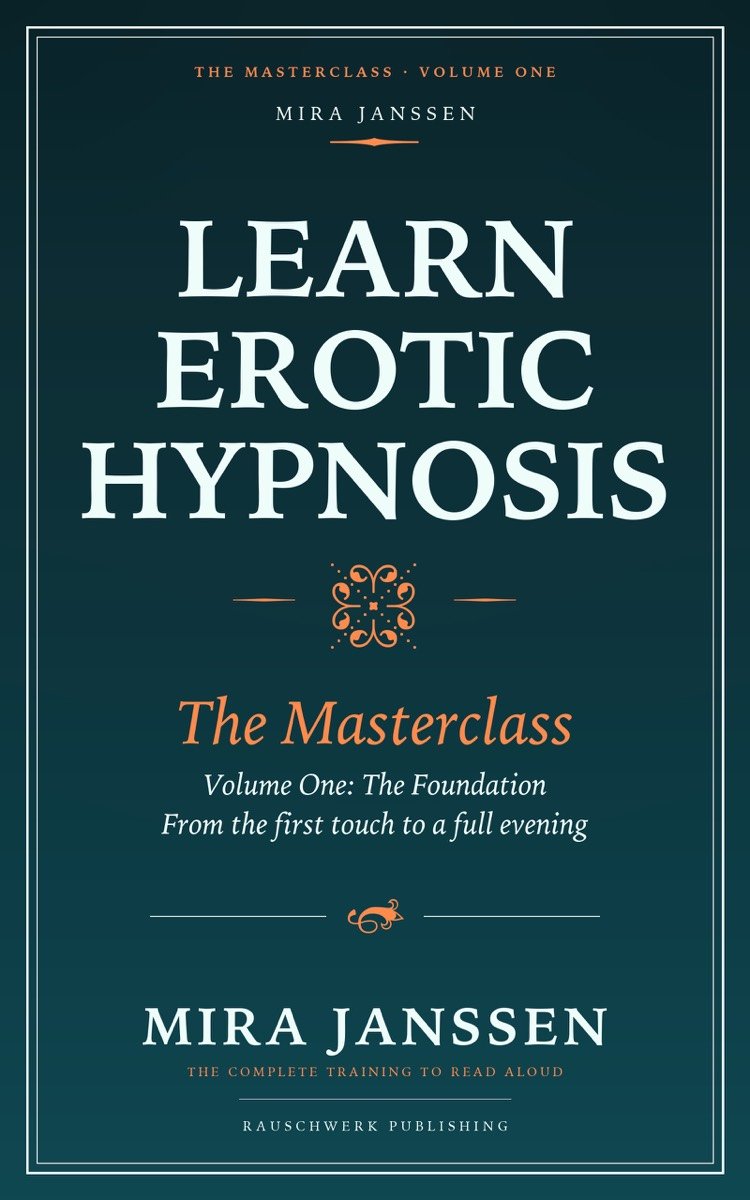
The foundation as a course rather than a reference: language, timing, reading the other person — in the order you actually learn them.
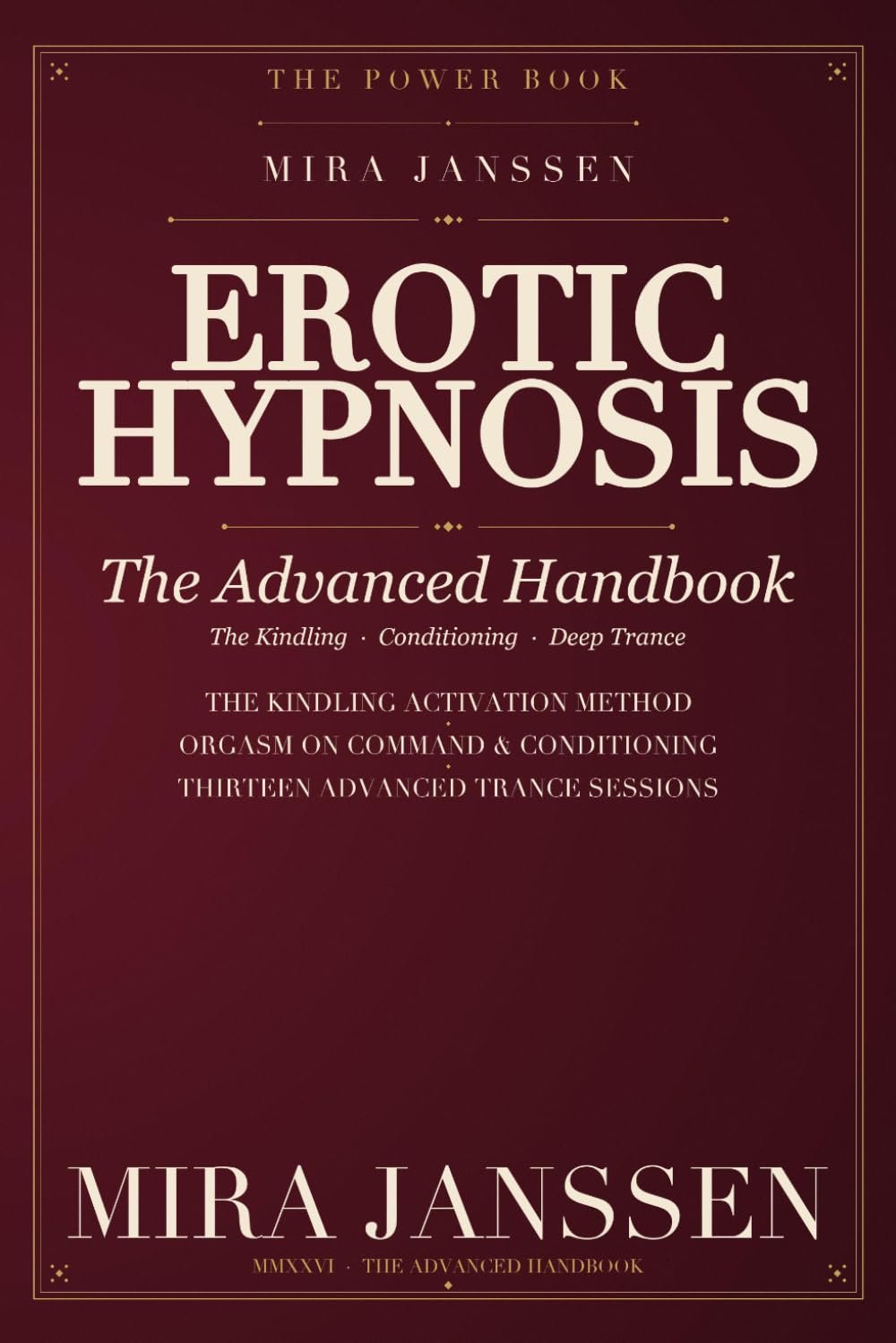
For anyone whose induction is already reliable and whose question has become what comes after it.