How Does Hypnosis Work? The Honest Mechanics, Minus the Mystique
People ask me this in two tones. Curious — how does hypnosis work — and suspicious, meaning: is there a mechanism at all, or are you all just acting? Both get the same answer, because there is only one. It is less spectacular than the films and considerably more interesting: a state assembled from entirely ordinary parts, every one of which can be named.
The short version
Hypnosis works by narrowing attention onto a single channel until the rest of the room stops being processed, which lowers the threshold at which a suggestion is accepted rather than examined. Nothing flows from one person into another. The state is built out of four ordinary components — fixation, monotony, expectation and permission — and the hypnotist's job is to arrange them, not to overpower anybody. She does not seize control of a mind; she sets up the conditions under which a mind stops multitasking.
The four working parts
1. Fixation. Every induction begins by giving attention a single home — a spot on the wall, a swinging pendulum, a voice, your own breath. Attention is a spotlight; hypnosis starts by shrinking it to a point. Everything outside the point gets quieter on its own.
2. Fatigue and monotony. Held attention tires. Eyes fixed slightly upward want to close after two minutes; a voice repeating calm, even phrases gives the prediction systems of the brain nothing new to chew. This is the same mechanism that makes motorway driving at night trance-like. The mind does not switch off — it stops patrolling.
3. Expectation. Whatever you believe hypnosis will feel like shapes what it feels like. This is not a flaw; it is the engine. Irving Kirsch gave the thing its name — response expectancy: what you anticipate happening to you contributes to making it happen. Skeptics quote that as a debunking. I quote it as a description of the motor, and it is why a competent hypnotist spends more time in the pre-talk than in the induction. The frame is the technique.
4. Permission. The step everyone underestimates. Suggestions work when the person has decided, somewhere quiet, to let them work. That is why nobody can be hypnotised against their will — the mechanism runs on cooperation, not conquest. What looks like surrender from outside is, from inside, a decision.
What is necessary, and what is merely usual
Ask ten people what hypnosis requires and nine will say relaxation. It does not. Relaxation is the common vehicle because it is pleasant and hard to get wrong, but I have watched the state arrive in people standing upright, under lights, at four in the morning, with a pulse nowhere near anything a relaxation script would permit. None of them would have used the word trance for it. A repetitive loop does the same job as a slow voice — hypnotic techno is a monotony engine with better production values.
Strip the thing back and only two elements are load-bearing. Absorption: attention narrowed onto one channel until everything else stops being processed as information. A lowered threshold for checking: the internal editor that normally asks is that true, do I want that, is that my arm stays in the building and stops interrupting. Closed eyes, heavy limbs, a slow voice, a countdown from twenty — scaffolding that makes those two easier to reach. Extremely useful scaffolding. Not the building.
The distinction has a practical edge. People who cannot relax on command decide they cannot be hypnotised, and they are wrong about the reason. They need a different door, not a different nervous system: movement, sound, a task that swallows the foreground.
How a session actually runs, in order
The four parts above are ingredients, not a running order. Sit in on a real session and you see four stages instead, and their sequence is not decorative.
The frame comes first. Long before anyone closes their eyes there is a conversation: what will happen, what will not, what it is likely to feel like, how it ends. Beginners assume this part is small talk and the induction is the real work. It is the other way round. The pre-talk is where expectation gets installed, and expectation is the motor. Someone told they will hear every word and feel pleasantly heavy will hear every word and feel pleasantly heavy. Someone braced for a blackout has been set up for one of two failures: nothing, or a performance.
Then fixation, which is the part everybody films. Attention given one home and held there until holding it costs something.
Then deepening. Counting down, closing and opening the eyes again, coming halfway up and going back down. Deepeners sound mystical and are not — they are fixation applied a second and third time to a mind that has already narrowed once. Nobody descends anywhere. It is rehearsal, and repetition is what turns a state into a shortcut.
Then suggestion, last, delivered into a system that has been prepared to take it. And then the way back out, on a timetable set before the start.
Most failed sessions I have watched did not fail in the induction. They failed because somebody skipped the first stage or the last one and then blamed the middle.
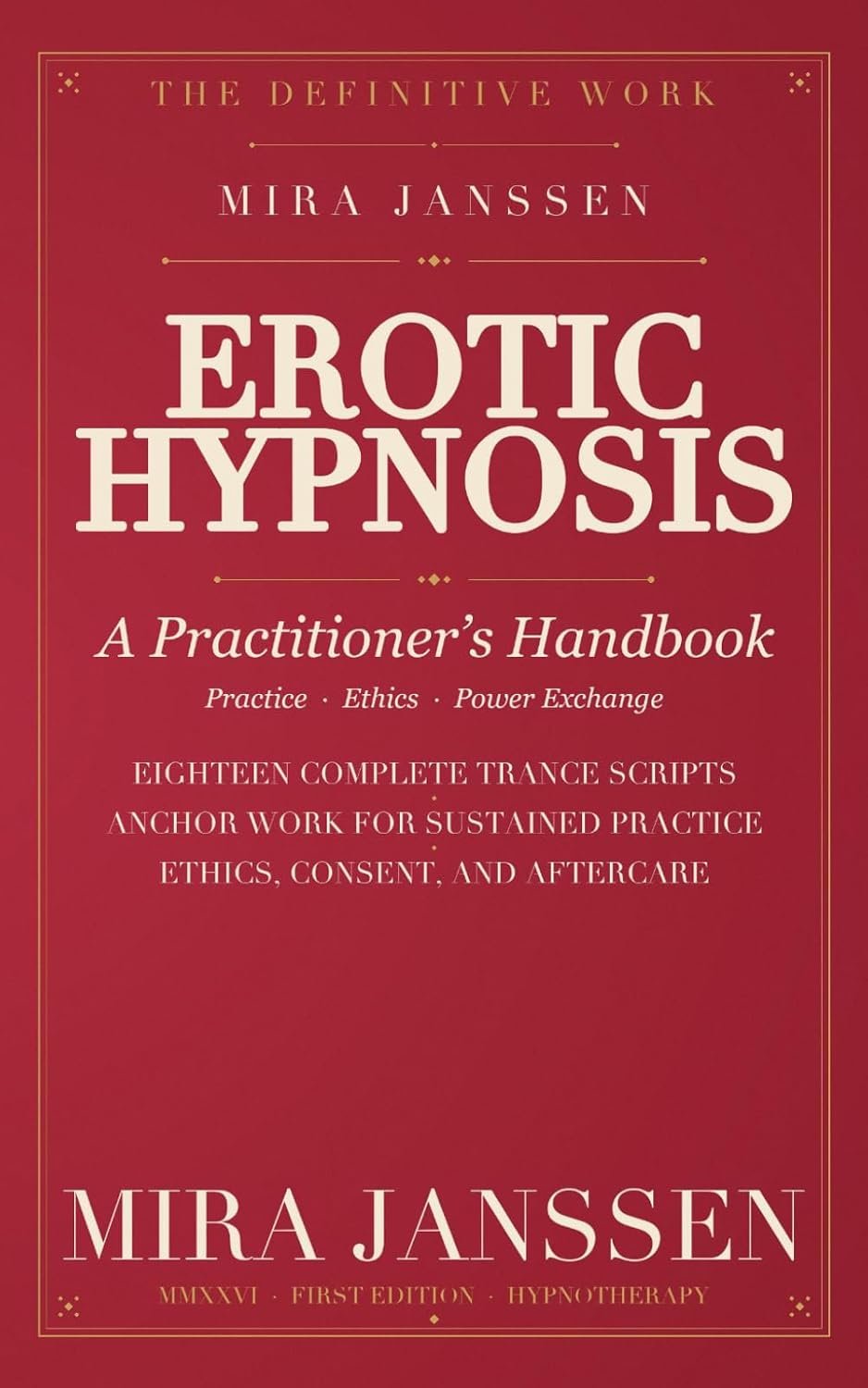
Eighteen complete sessions written out to read aloud — from the first agreement to the way back. The book for turning one attempt into a repertoire.
See the bookWhat happens in the brain
Neuroimaging of hypnotised subjects shows a consistent pattern: activity shifts in the anterior cingulate cortex (the conflict monitor), connectivity changes between the executive control network and the default mode network (the self-commentary channel), and the insula changes how body signals get weighted. Translated: the region that usually says "wait, let's double-check this" goes quieter while absorption deepens, and the volume knob on bodily sensation turns out to be reachable from outside. Nobody leaves their body. The commentary track just gets turned down.
Now the ceiling, because it rarely survives the trip into a headline. These are group-level, statistical differences. There is no hypnosis centre and no single switch, and the effects appear most clearly in people who were already highly responsive before they got into the scanner. No technician can look at an image and certify that this person is in trance on this evening. Imaging establishes that the state has a signature, not that it has an address. Work from David Spiegel's group at Stanford has kept recovering a version of the same picture over years, and it is that reproducibility rather than any single striking scan that makes the case — a room full of people being polite does not produce a pattern that keeps coming back. Which is the whole of why hypnosis is real without being magic. Measurable, and still nothing more exotic than attention behaving unusually for twenty minutes.
Why it is not sleep
The name is a historical accident and the man responsible said so himself. James Braid, a Manchester surgeon, went to a demonstration of animal magnetism in 1841 expecting to catch a fraud and failed to. What he concluded instead was that nothing passed between the two people at all — no fluid, no force, just sustained fixation of attention doing something inside one nervous system. Two years later he published Neurypnology and left us the word, built on hypnos, sleep.
He came to regret it, and later proposed monoideism instead: the condition of being occupied by one idea. Nobody adopted it, which is a pity, because monoideism describes the mechanism accurately and hypnosis describes it wrongly.
Sleep is a withdrawal from processing. This is the opposite — processing narrowed onto one channel and turned up. Asleep you cannot take an instruction, hold it and report on it afterwards; in trance that is the entire job. The overlap that confuses people is real: plenty of sleep hypnosis audio does put listeners to sleep and is designed to. But it gets there the way a dull lecture does. Sleep is what happens when the session stops, not what the session is.
Why two people describe the same session differently
Same room, same voice, same script. One person comes out saying her arm lifted on its own and she could not have stopped it if she had wanted to. The other spent twenty minutes assembling a shopping list and being polite about it. Both are reporting honestly, and each is quietly certain the other is lying.
Ernest Hilgard's work at Stanford produced the standardised scales that measure this, and the finding has held up for decades: hypnotisability behaves like a trait. Fairly stable across years, roughly normally distributed, sorting people into a small group who respond dramatically, a small group who barely respond at all, and a large middle who respond moderately given a decent guide and some patience.
That one fact settles more arguments than it is ever given credit for. The mechanism is the same for everybody; the outcome is not, and the difference was largely in place before either person got curious. It is also not a grade — being highly hypnotisable is not the same thing as being easily fooled, however much the folklore would like it to be. If you want a rough idea of where you sit, a suggestibility test will tell you more in ten minutes than a fortnight of reading.
What it feels like (and why people miss it)
Most first-timers open their eyes and say: "I heard everything. I could have moved. Was I even hypnotised?" Yes — that is exactly what it is. Trance is not unconsciousness; it is effortless focus with the critic on standby. The ideomotor effect — your body executing an imagined movement without a decision — is the cleanest proof that something real shifted, which is why small tests like a swinging pendulum convince people faster than any explanation.
The experience gets missed because people are checking for the wrong signal. They wait for an absence and get a presence: one thing filling the whole foreground while everything else goes quiet at the edges. You have had it on a train, and three pages into a book you did not mean to start. Nobody calls that hypnosis, because nobody said the word beforehand.
What the mechanism cannot do
Any honest account of how hypnosis works has to say what this arrangement cannot produce, because if I leave the gap the folklore fills it.
It cannot take control. Nothing is transferred; there is no channel for it. The state runs on cooperation, and cooperation is withdrawable at any second by the ambitious method of opening your eyes. It cannot switch you off. You hear, you remember, you could stand up and leave. It cannot make somebody act against something they actually care about. Push a suggestion past that line and you do not get obedience, you get the end of the session: the critic comes back on duty at exactly the moment there is something worth checking, which is what it is for.
And it cannot be done to a person who is refusing. That is not an ethical rule bolted on afterwards to make the craft look respectable — it falls out of the mechanism. Absorption cannot be taken by force. Fight someone for their attention and all you have is their attention on the fight.
Where the levers lead
Everything else in this craft — inductions, deepeners, suggestion wording, anchors — is engineering built on these parts. If you want to see them isolated one at a time, start with what trance actually is. If you want to run them on yourself first, the self hypnosis techniques are the cheapest laboratory available and the only one where you own both chairs. And for the order of learning laid out properly, learning hypnosis is where to begin.
Knowing the mechanism does not spoil the experience, incidentally. That is the first thing people ask once they believe the rest, and the answer has been no every time I have tested it. Understanding how a chord is built has never stopped a song from working.
What these four parts can build between two consenting adults is a different subject, and it is the one my books are for.
Eighteen complete sessions written out to read aloud — from the first agreement to the way back. The book for turning one attempt into a repertoire.
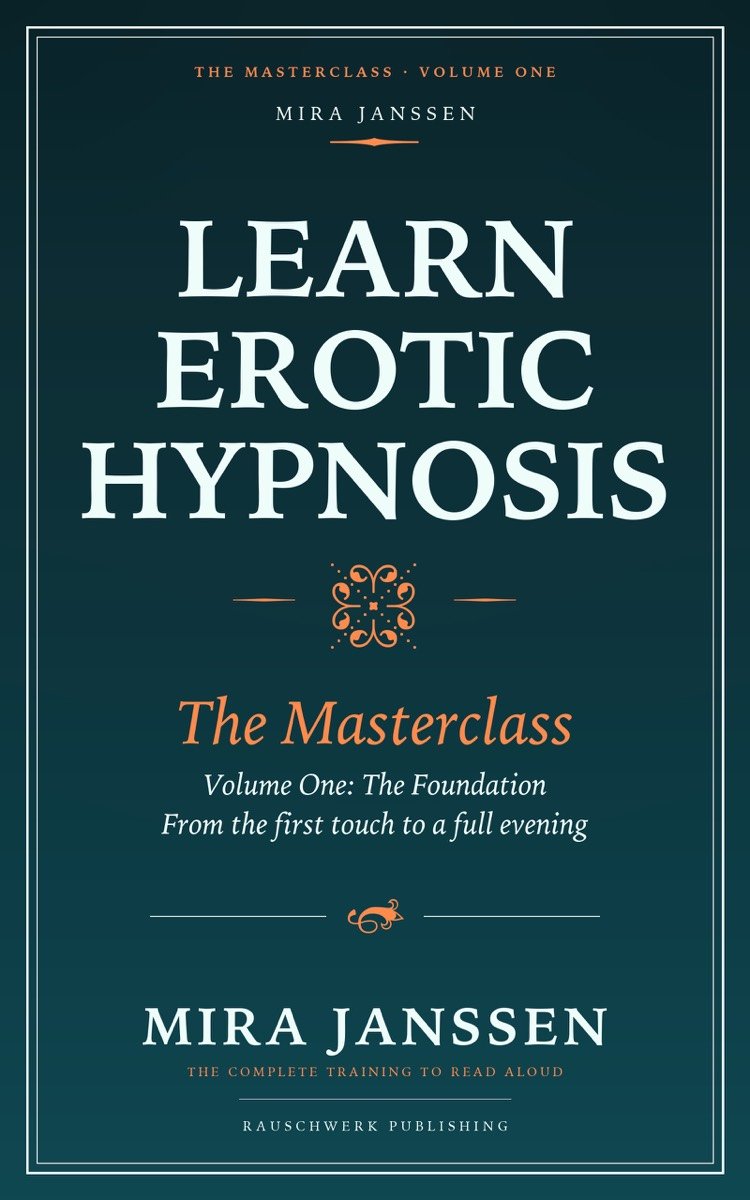
The foundation as a course rather than a reference: language, timing, reading the other person — in the order you actually learn them.
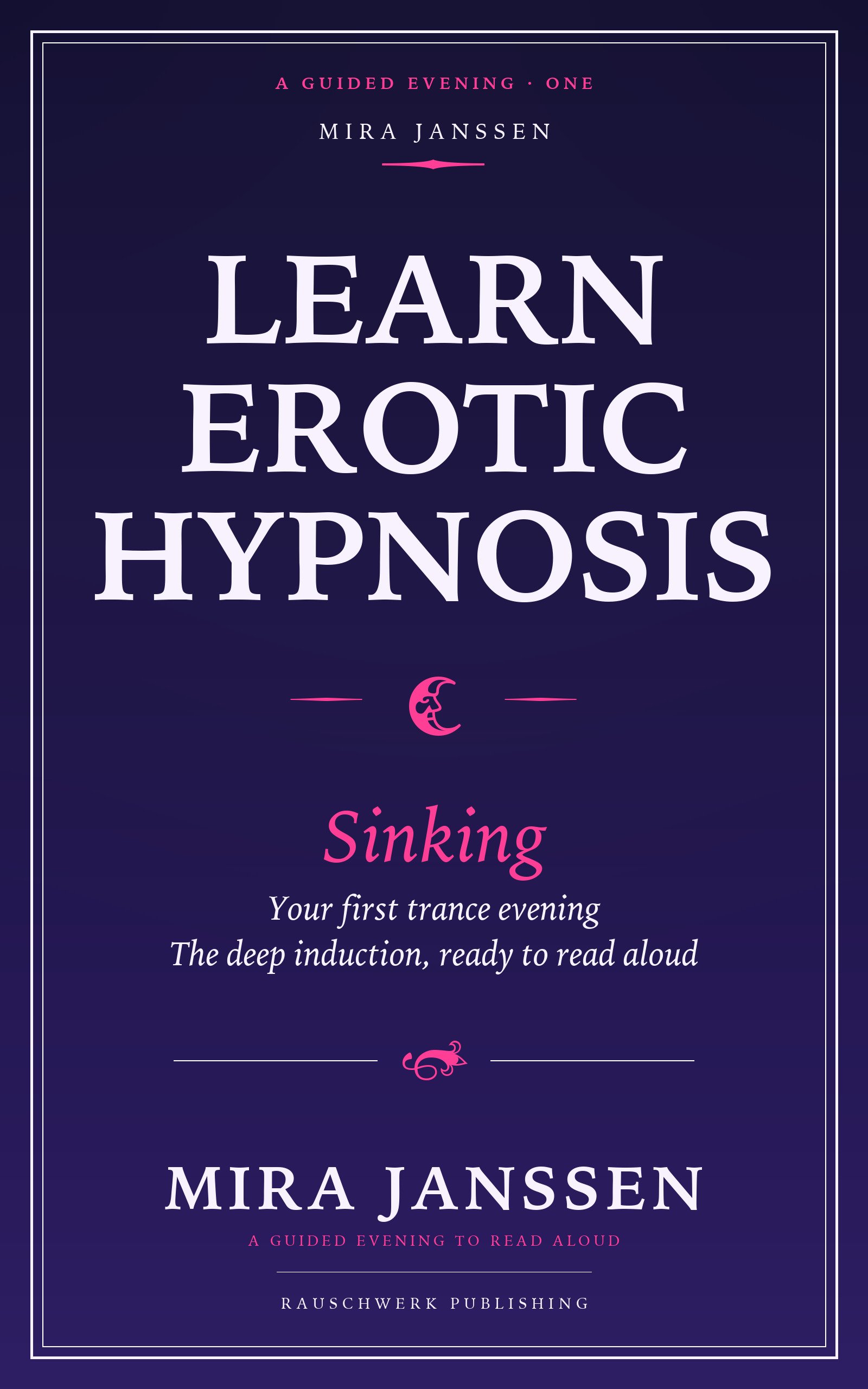
One guided evening, written out word for word. For anyone who doesn't want to understand trance so much as run one tonight.
— Mira
FAQ
Is hypnosis scientifically real? Yes. The state shows measurable changes in brain activity and network connectivity, and hypnosis has documented clinical uses, most consistently in pain. What is not real is the Hollywood version — mind control, amnesia on command, clucking strangers.
Can everyone be hypnotised? Not equally. Hypnotisability behaves like a stable trait spread out roughly like height: a small group responds dramatically, a small group barely responds, and most people land in a workable middle. Willingness, trust and a competent guide move almost everyone further along the scale than they expect.
Can you be hypnotised against your will? No. The mechanism runs on narrowed attention and permission, and neither can be taken by force. Pressure produces resistance, which is the exact opposite of absorption.
Is hypnosis sleep? No, and the name is the problem — Braid himself wanted rid of it. Sleep withdraws from processing; hypnosis narrows processing onto one channel and turns it up. You hear, you remember, you could act. You simply do not feel like interrupting.