The Subconscious Mind Is Not a Room You Can Talk Into
I use the phrase professionally and I trust it about as far as I can throw it. Subconscious mind sounds like a second person under the floorboards, one with opinions, a filing cabinet and a letterbox you can post instructions through. What it actually names is duller and far more useful: everything your system gets on with while you are busy being you.
What the subconscious mind actually is
The subconscious mind is not a place and not an agent. It is a collective noun for the processing that runs without conscious attention — perception assembling a scene before you look at it, motor routines you stopped supervising, emotional appraisal that finished before you noticed the mood, associations laid down by repetition. All of it real, all of it ordinary, none of it disputed.
What the phrase does not name is a second self with its own agenda, its own vault and a door you can be handed the key to. That is a story about the mind, not a finding about it, and it is what most of the first page of a search is selling.
The distinction sounds academic. In my trade it decides whether you understand what you are doing or end up paying someone who doesn't.
An adjective that quietly grew an article
Unconscious started life as a description — a way of saying: this happened, and you did not notice it happening. Modest, accurate, no furniture. Then it acquired an article and became a location. Once a process is a place, the place can have contents. Once it has contents, they can be reached. Once they can be reached, somebody can sell you the route. The slide happens in the grammar, not in the evidence. We talk about traffic the same way — traffic was in a foul mood tonight, traffic decided to die on the ring road — and nobody believes there is a mind in there.
There is a stricter position than mine, argued seriously inside psychology and never quoted in the self-help literature: no evidence for a subconscious in the popular sense at all, only many separate processes wrongly bundled and then promoted to a character. I think it overshoots. It is still an excellent antidote.
What is genuinely well established
None of that means you are transparent to yourself. You are not, and the evidence is everywhere, including in every room I have worked.
Motor learning is the least controversial case. A DJ I have shared a stage with for years talks to me about his landlord while his hands do something I could not manage with my whole attention. Early on it was conscious and effortful. Now it is neither, and if he starts thinking about it he gets worse.
Perceptual pre-processing is that story a layer down. You never decide to see a face; by the time an image reaches you it has been sorted into edges, depth, movement and person. In a room loud enough that you order drinks by pointing, someone says your name three metres away and you turn — something was reading that noise all along.
Then implicit learning. Nobody taught you the order adjectives take in front of a noun in your first language, but you would hear it instantly if I broke it. The regulars on a dance floor anticipate a drop they could not describe. And habit, which is only this made durable.
That is plenty, and none of it needs a hidden author. All it needs is a nervous system that does more than it reports. The everyday version is the drive home that happens while your head is elsewhere and leaves you in your own hallway with no account of it — highway hypnosis, nothing mystical in it.
Freud, fairly
Freud was formative and Freud was wrong about the machinery, and both can be said in one breath. His central intuition held up — most of mental life is not open to inspection from the inside — but the architecture he built on it is not what current research uses.
The popular word is not even his. He wrote about the unconscious; "subconscious" came out of the French tradition, where Pierre Janet used it, and Freud rejected it outright as imprecise and misleading. The self-help subconscious mind is a flattening of a concept, borrowed under a name its most famous supposed owner refused to use.
His unconscious was no friendly assistant either. It was where the unacceptable went: conflicted, defended, kept out of view. The wellness version is a benevolent partner who wants your best and merely needs the right phrasing. That is not a simplification of Freud, it is a different claim wearing his coat.
What is actually happening in a session
Here is a sentence I have heard in green rooms and once from a man introducing me on stage: this goes straight to your subconscious. It always lands. It is a picture, not a procedure.
What is actually happening has four ordinary parts. Attention narrows onto a small field and stops sampling the rest of the room. The auditing voice, the one that checks a claim before you are allowed to feel anything about it, gets quieter rather than absent. Imagined content turns vivid enough that the body treats it as worth responding to. And expectation carries much of the rest, because what you believe is about to happen to you shapes what happens to you. Those four are all there is to how hypnosis works, and the state they produce is far less exotic from inside than anyone hopes.
Nothing in that list is a bypass. If a channel really did run underneath a person's consent, the abuse would be trivial and this craft indefensible. There is no such channel, which is why everything depends on cooperation, and why a suggestion cutting against what someone actually wants simply gets declined.
The clearest demonstration is the smallest. Hold a weight on a thread, think steadily about it swinging, and it swings, moved by muscle activity you did not order and cannot feel. That is the ideomotor effect: your own expectation arriving through your own hand and not feeling like yours. Every "the subconscious answered" demonstration in this field runs on that gap.
It matters most at the level of practice. Somebody who believes they are programming another person's subconscious stops watching them: the model says the real work is happening somewhere invisible. Somebody who knows they are working with attention and expectation watches the face in front of them, because that is where the information is. At the erotic end of this work, that is the whole distance between careful and reckless.
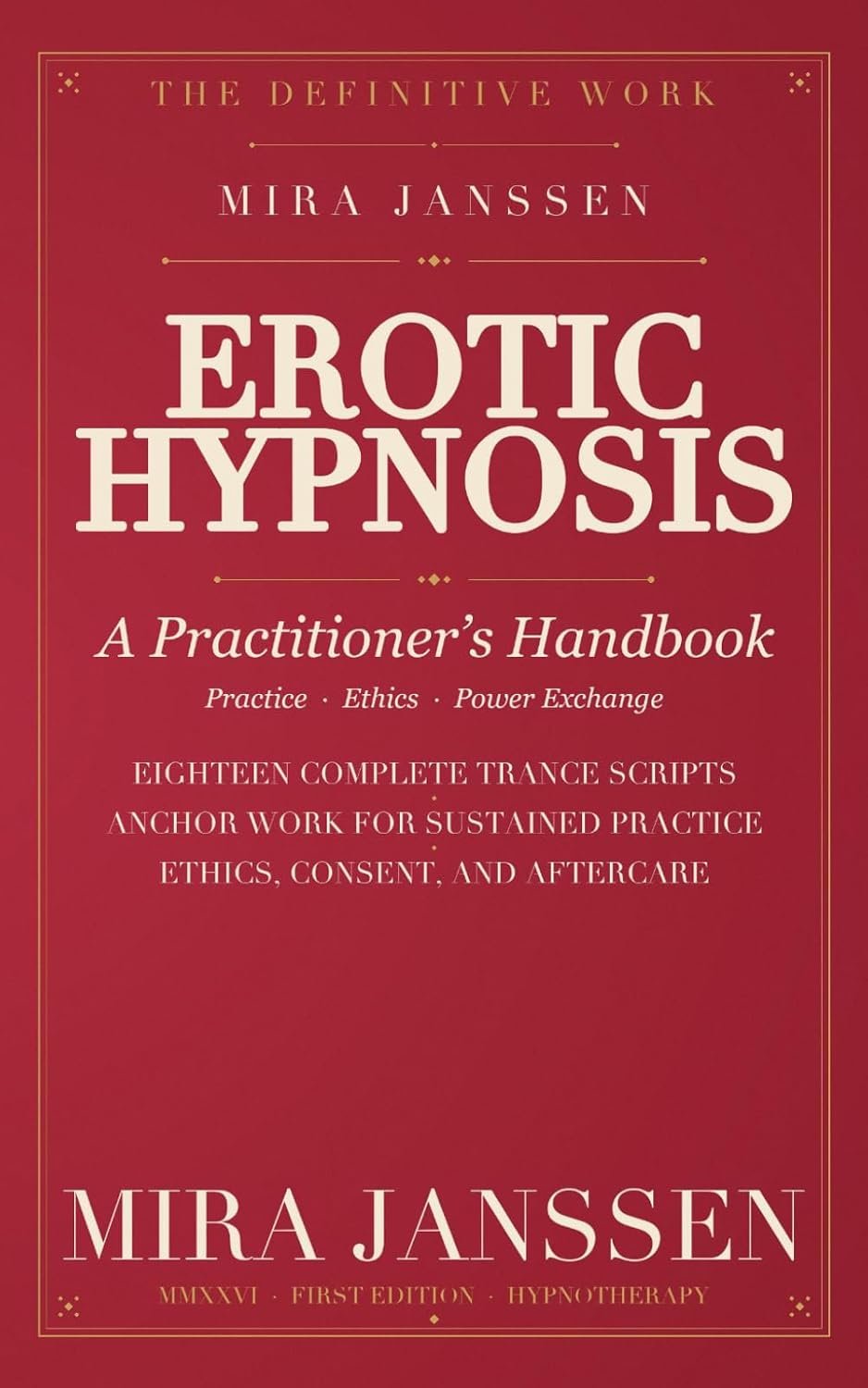
Eighteen complete sessions written out to read aloud — from the first agreement to the way back. The book for turning one attempt into a repertoire.
See the bookWhy the metaphor refuses to die
Three reasons, and only the last is cynical. It is convenient — everyone knows roughly what you mean, whereas "the set of processes running outside your awareness" is not a phrase you can use twice and keep the room.
It explains self-sabotage without blame. If a hidden part is running things, the person who keeps doing what they swore off last month is not weak, they are outvoted. That is a kind story and it does real work. I do not take it off anybody at three in the morning while they explain their divorce to me.
And it sells. A power centre you cannot reach unaided needs an intermediary, which is a business model with treasure buried at the bottom. This is where you meet the number: ninety-five percent of your behaviour, supposedly, run by your subconscious. Sometimes ninety. Sometimes ninety-eight. Go looking for the source and there isn't one — it gets handed from page to page, occasionally with a citation bolted on to research that measured something else. "Your nervous system handles more than you notice" became "somebody else decides for you", which is what the course is priced on.
What I say instead
I still use the words, because everyone understands them and I am not in the business of correcting strangers at a bar. What I stopped doing is giving them verbs. It does not want, decide, protect or resist. I say: something is running that you are not watching. Better still, I name the thing — that is a habit, that is expectation, that is your attention having gone elsewhere.
Unglamorous sentence. Its advantage is that it is true.
People assume this shrinks the work. It does the reverse. If there is no second self in there, everything that happened in that room happened in the person in front of me: their attention, their imagination, their permission, their body. Nothing was installed and nothing was slipped past anybody. They built it out of words and timing, and then handed me the credit on the way out.
That is a larger claim than the fairy tale, not a smaller one, and it moves the interesting question. Not what is hiding inside you, but how much of that capacity you have and what you would do with it. Ten minutes with a suggestibility test answers the first part, and whether the state is real at all is worth settling before you pay for anyone's opinion. What two consenting adults build once they stop arguing about hidden compartments is what my books are for.
Eighteen complete sessions written out to read aloud — from the first agreement to the way back. The book for turning one attempt into a repertoire.

The foundation as a course rather than a reference: language, timing, reading the other person — in the order you actually learn them.
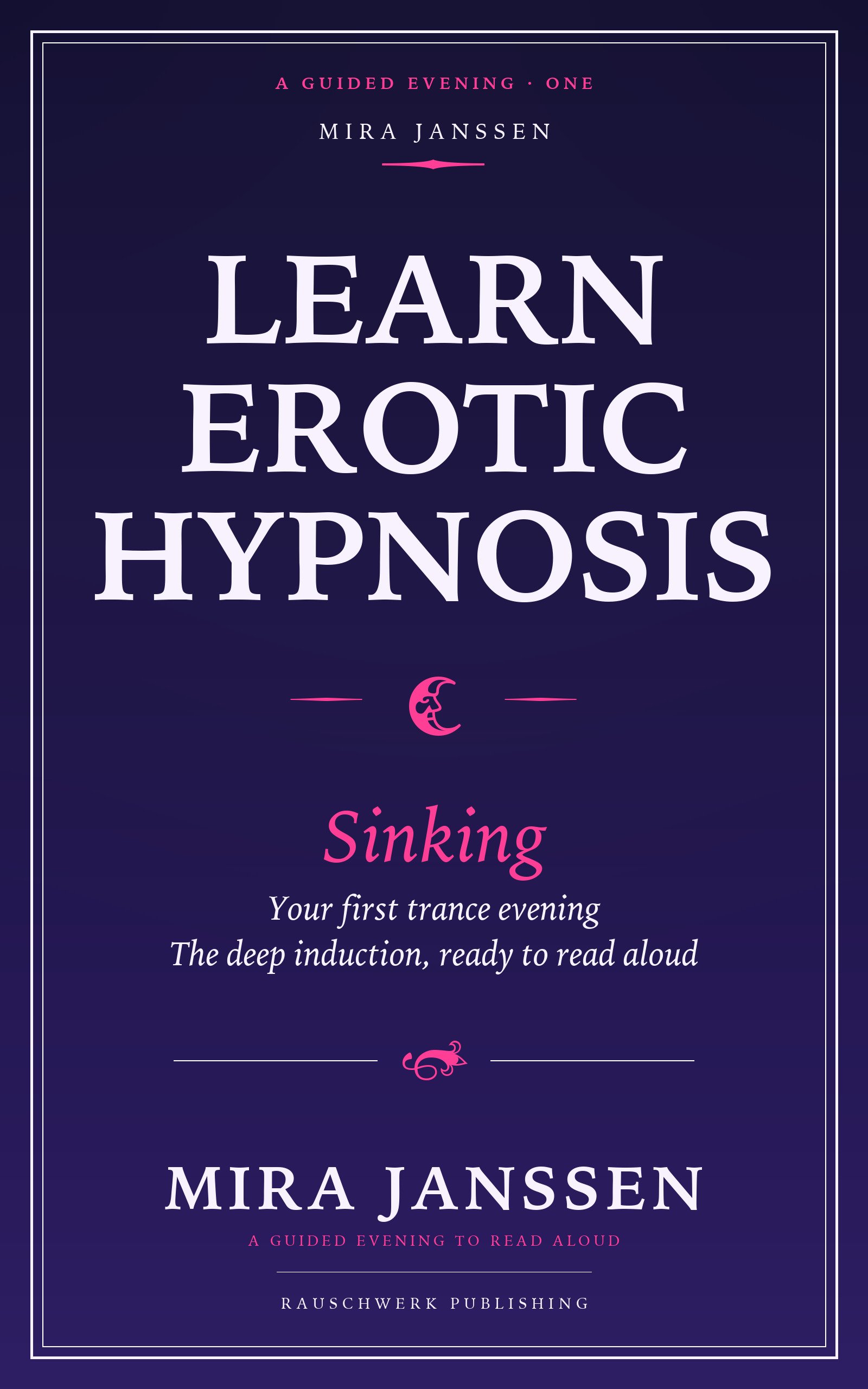
One guided evening, written out word for word. For anyone who doesn't want to understand trance so much as run one tonight.
— Mira
FAQ
What is the subconscious mind, exactly? A collective name for mental and bodily processes that run outside conscious awareness — automated movement, pre-conscious appraisal, implicit memory, learned association. Not a location in the brain, and not an entity with intentions of its own. The word gathers unrelated processes under one heading and makes them sound like one thing.
Can you reprogram your subconscious mind? Not in the sense the word implies. Habits, reactions and expectations do change, through repetition, experience and practice, sometimes helped along by trance work. That is learning, not overwriting. Anyone promising to reprogram you is selling a picture rather than a method.
Does hypnosis speak directly to the subconscious? No, and it does not need to. Attention narrows, the critical voice gets quieter, imagery turns vivid and expectation does much of the rest. Everything a session produces can be accounted for that way, without a hidden second self and without any channel running underneath the person's consent.
Subconscious or unconscious — which is correct? In the technical literature "unconscious" is standard and "subconscious" is treated as a popular expression; Freud used the former and explicitly rejected the latter. As an adjective, "unconscious processing" is fine and describes something real. It is the noun with an article in front of it that quietly invents a resident.